Sarfaraz Khan’s return to India’s Test squad has added another name to a curious list that Chennai Super Kings have been building almost since the beginning of the IPL: players whose international careers have found fresh life after a stint in yellow.
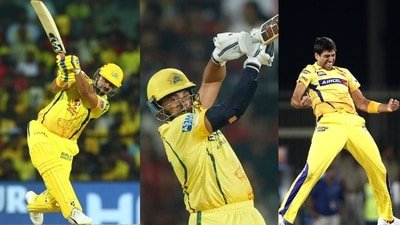
Sarfaraz was initially overlooked for India’s two-Test tour of Sri Lanka, having remained outside the national side since the Mumbai Test against New Zealand in November 2024. When Sai Sudharsan was subsequently ruled out with a stress reaction in his right toe, however, the selectors turned to Sarfaraz ahead of the first Test in Galle beginning August 15.
It would be simplistic to credit CSK alone for the recall. Sarfaraz’s formidable first-class record remained the principal foundation of his Test case, while he had also transformed his fitness and continued accumulating runs away from the IPL. But Chennai provided another important piece of evidence in 2026: that the 28-year-old could reinvent himself rather than merely wait for another opportunity.
Bought for ₹75 lakh after two seasons outside the IPL, Sarfaraz scored 161 runs for CSK at a strike rate of 169.47. The volume was modest because his opportunities were limited, but the manner of the runs was striking. His season included a 25-ball 50 against Royal Challengers Bengaluru and a 12-ball 32 against Punjab Kings. For CSK, there is considerable history behind that kind of revival.
From Raina and Nehra to Dube: CSK’s comeback trail
Suresh Raina provided one of the earliest examples in 2008. Having dropped out of India’s ODI side in early 2007, Raina entered the inaugural IPL with his international career at a crossroads. He scored 421 runs for CSK at a strike rate of 142.71, including three half-centuries, before returning to India’s limited-overs side. Raina himself later said the IPL success had worked wonders for his confidence as he began what effectively became the second phase of his international career.
Lakshmipathy Balaji’s comeback was even more dramatic. Serious back injuries had taken him out of international cricket after 2005 and forced him to remodel his bowling action. When he returned through CSK in 2008, Balaji produced the first hat-trick in IPL history. He followed that with 36 wickets during the 2008-09 domestic season before an injury to Munaf Patel opened the door for an India recall in Sri Lanka in January 2009 — almost four years after his previous international appearance.
Ashish Nehra repeated the pattern on an even larger scale. Nehra had not represented India since the 2011 World Cup when CSK signed him. At 36, and after a career repeatedly interrupted by injuries, his international days appeared to be over. Instead, IPL 2015 became one of the finest seasons of his career: 22 wickets at 18.54 with an economy rate of 7.03. India finally recalled him for T20Is at the end of that year. Nehra went on to become a regular member of the T20 side, helping India beat Australia 3-0 away and playing in the 2016 T20 World Cup.
Ambati Rayudu followed in 2018. His first season with Chennai produced 602 runs at a strike rate of 149.75, comfortably the highest aggregate of his IPL career at the time. India selected him for the ODI tour of England before a failed fitness test delayed his comeback; he eventually returned during the Asia Cup later that year and briefly became India’s preferred candidate at No.4.
Ajinkya Rahane’s revival in 2023 was slightly different but equally revealing. By then, Rahane had been outside India’s Test side for 16 months and had developed a reputation in the IPL as a conservative batter whose best T20 years were behind him. CSK changed his role, encouraging him to attack rather than anchor. The results were immediate. His early-season assault included 61 from 27 balls against the Mumbai Indians, and his transformed approach pushed him back into the national conversation. When India named their squad for the World Test Championship final, Rahane was recalled. Injuries to Shreyas Iyer, Rishabh Pant and Rahane’s domestic form were important factors, so attributing the selection solely to the IPL would be misleading; nevertheless, his CSK transformation dramatically altered perceptions around him.
Also Read: India vs Afghanistan T20I series dates confirmed; Direct clash leaves Bangladesh tour facing near-certain cancellation
Shivam Dube provides perhaps the clearest modern example. Dube had not played a T20I for India since February 2020, when CSK began reshaping his career. Rather than demanding that he establish himself as a conventional seam-bowling all-rounder, Chennai concentrated on his most destructive asset: middle-overs power, particularly against spin. After scoring 289 runs in 2022, Dube amassed 418 at a strike rate of 158.33 in IPL 2023 as CSK won the title. He was subsequently recalled by India for the Ireland series after an absence of more than three years and eventually became part of India’s 2024 T20 World Cup-winning squad.
The pattern has not been restricted to Indian players.
Dewald Brevis went unsold at the IPL 2025 auction before CSK recruited him midway through the season as an injury replacement. In six innings, the South African smashed 225 runs at a strike rate of 180, restoring much of the momentum that had disappeared after his emergence as one of world cricket’s most exciting young batters.
Sarfaraz, therefore, enters a lineage extending from Raina and Balaji to Nehra, Rayudu, Rahane, Dube and Brevis. There is no magic formula, and every comeback had different causes. Injuries created openings for some; domestic performances strengthened the cases of others. But CSK’s recurring contribution has been more specific: identifying a role for players whose value had become uncertain, trusting them in that role, and allowing performances to change the conversation around their careers.
For Sarfaraz, the Test recall is not the conclusion of that process. It is the opportunity the process has helped him reach.