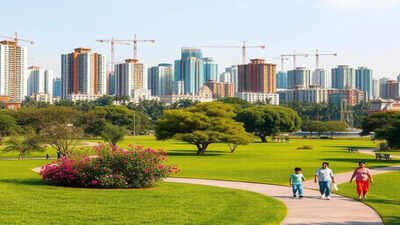
Delhi remains one of North India’s principal economic and employment hubs. However, the process of acquiring land for planned development has grown increasingly tedious, often delayed by litigation and procedural bottlenecks.This has left the Delhi Development Authority (DDA) unable to keep pace with the city’s rising population and market demand. In response, DDA has repositioned itself by moving away from its traditional role as a land developer to that of a facilitator, enabling landowners themselves to drive development through pooling.What is land pooling?Land pooling is a mechanism under which private landowners voluntarily combine their land parcels for planned development, in partnership with DDA, rather than having their land acquired outright.Owners or groups of owners pool their holdings as per prescribed norms, becoming stakeholders in the development process instead of merely surrendering land for compensation.Where will it apply?The policy covers the urban extension areas of Delhi, spanning 104 villages across Zones J, K-I, L, N, P-I and P-II. This area has been divided into 109 sectors, each averaging 250 to 350 hectares and expected to house between 80,000 and one lakh people.These zones are being planned around Smart City principles, along with global concepts of happiness and livability indices. DDA notified the modified Land Policy and its accompanying Regulations in 2018 to operationalize this framework.Scale of developmentThe policy envisions development across roughly 200 sq km (20,000 hectares) of land, aimed at meeting Delhi’s housing and infrastructure needs over the next two decades.Around 17 lakh new housing units are proposed, of which six lakh will be reserved for Economically Weaker Section (EWS) housing, together expected to accommodate about 85 lakh people.How the pooling model worksUnder the framework, a landowner or group of landowners holding a minimum of two hectares can form a Developer Entity (DE) or Consortium. Once at least 70% of the developable area in a sector is pooled and ownership is verified by the Revenue Department, the sector becomes eligible for development.Of the pooled land, up to 60% is retained by the DE/Consortium for residential, commercial and public-semi-public use, while the remaining 40% is surrendered for city-level infrastructure such as roads and recreational facilities.Landowners holding less than two hectares outside a DE become eligible for built-up space rather than a separate developed parcel.Expected economic impactBeyond housing, the policy is expected to spur broader economic activity. Construction and allied sectors, including housing and infrastructure finance, are likely to generate direct and indirect employment.Officials note that labour-intensive domestic production linked to this development could further benefit the local economy, creating a multiplier effect that adds to the city’s overall economic output.