Three king cobra nests discovered by residents in Yunnan, China, have given scientists an unusually close look at a part of the snake’s life that remains poorly documented. The nests, found between 2020 and 2025 in different parts of the province, contained 30, 72 and 25 eggs. The largest clutch, found west of Kunming, was particularly unexpected, with two king cobras observed guarding the same nest during several visits. Scientists could not establish the snakes’ sexes, leaving open the possibility that two females had contributed to the unusually large clutch. The other nests were found in bamboo forests, including one where young king cobras were later seen emerging. The observations are significant because they represent the first documented king cobra nesting and clutch-size records in China outside the Xizang Autonomous Region. The findings also add to growing evidence that the species’ nesting behaviour may be more varied than previously recorded. The observations provide rare evidence of how king cobras reproduce in the wild, offering new clues about their nesting behaviour and social interactions.
Two king cobras guarded a nest near Kunming in 2024
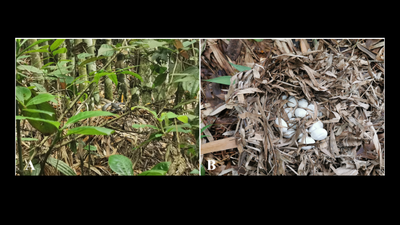
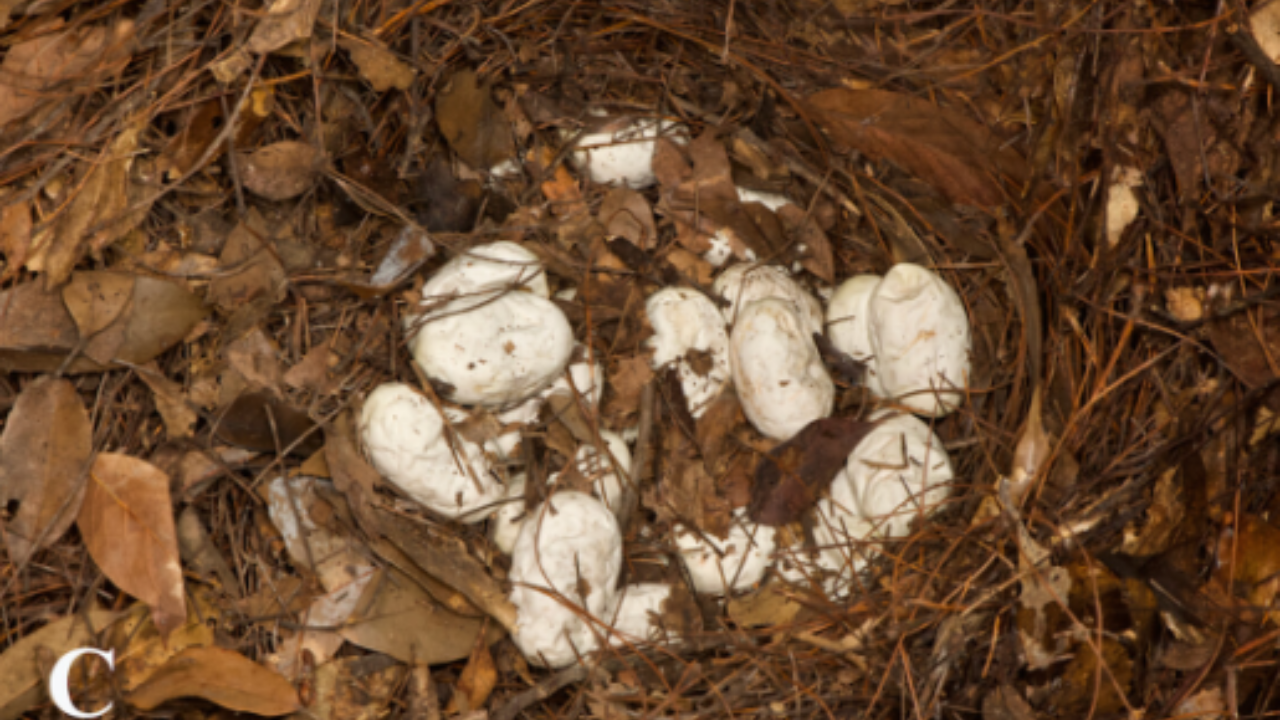
According to the study published in Integrative Conservation, titled ‘Novel Natural History Observations on the Reproductive Biology of King Cobra (Ophiophagus hannah) From Yunnan Province, China’, the first nest was found on 10 July 2020 in Menghai County, in Xishuangbanna Dai Autonomous Prefecture in southern Yunnan. Local residents came across it in a tropical bamboo forest at an elevation of about 1,730 metres. The nest was made largely from bamboo leaves and an adult king cobra was guarding it, believed by the researchers to be a female.Once the snake had moved away, the nest could be examined. Inside were 30 eggs, with developing embryos visible when the eggs were illuminated with a strong light. The observation was important because, before these records, documented information about king cobra nesting in China was largely confined to southeastern Xizang. The authors describe the three Yunnan observations as the first documented nesting and clutch-size records for the species in China outside that region.The second discovery was made several years later, on 6 June 2024, in a mixed forest west of Kunming. This time, residents found two king cobras at a nest made from pine needles. The snakes were still there when researchers returned on 1 July, with one measuring about 1.8 metres and the other more than 2 metres long.The nest itself was changing as the snakes continued working on it. By the July survey, it stood roughly 1 metre high and measured around 1.5 metres across. The researchers later found 72 eggs packed towards the centre of the structure. The eggs sat roughly half a metre above the ground and below the upper layer of nesting material. Temperatures inside the nest were estimated at between 35°C and 40°C, considerably warmer than the surrounding air.
PC: Novel Natural History Observations on the Reproductive Biology of King Cobra (Ophiophagus hannah) From Yunnan Province, China
Scientists find new evidence of group guarding in king cobras
The Kunming nest was unusual for another reason. Two king cobras were seen guarding it during the early observations, and both remained at the site during a second survey on 11 July. By 20 July, however, only the larger snake was still there. It eventually left the nest without incident when the researchers approached.The observation matters because the question of whether several king cobras can participate in guarding the same nest has remained uncertain. Older accounts had described both sexes taking part in nest guarding, but more recent field studies had not confirmed this behaviour. The authors say the Kunming observation provides new evidence that multiple individuals can participate in guarding a king cobra nest. They could not determine the sex of either snake, so the observation does not establish exactly how the two individuals were related or what role each played.The unusually large clutch found there made the situation even harder to explain. King cobra clutches reported in earlier studies have generally ranged from 14 to 37 eggs. Seventy-two eggs is far beyond that range and, according to the authors, is the largest clutch reported in published studies of Ophiophagus hannah in the strict sense.There are a couple of possibilities. The nest could have belonged to a single mating pair, with one female producing an exceptionally large clutch. The researchers also raise another explanation: two females may have nested together, combining their eggs in one nest. The fact that the 72 eggs were roughly twice the size of clutches recorded elsewhere lends some support to that idea, but the researchers stress that they could not determine the snakes’ sexes. It remains a hypothesis rather than a conclusion.
King cobra nest in Yunnan contained 25 eggs
The third nest was found in Lancang County, Pu’er City, south-central Yunnan, on 17 June 2025. Residents again made the initial discovery. They reported seeing two adult king cobras guarding the nest, although only one was present when the researchers visited.This nest was smaller than the one near Kunming. It had been built in a bamboo forest from bamboo leaves and twigs, measuring about 95 centimetres across at its base and roughly 50 centimetres high. Once the guarding snake left, researchers found 25 eggs inside, joined together as a single cluster. The temperature within the nest was about 26°C, the same as the surrounding air.The nest also offered something the other observations did not: a chance to see what happened after the eggs were laid. Juvenile king cobras were first observed emerging from the nest on 19 August 2025. That gave the researchers a direct record connecting the nesting site with successful hatching, adding another piece to an otherwise limited picture of reproduction in the species.The 25-egg clutch also sits comfortably within the range of previously recorded king cobra clutches. That makes the 72-egg Kunming nest stand out even more. Taken together, the three nests contained 30, 72 and 25 eggs, showing how much clutch size can vary between individual nesting events.
King cobra nesting records help fill a geographical gap in China
King cobras are unusual among snakes because they construct nests and guard their eggs. Yet despite being one of the world’s best-known venomous snakes, their reproductive biology is still poorly documented across much of their range.The study notes that earlier work has been concentrated largely in the eastern Himalaya, where recorded clutches have ranged from 14 to 37 eggs. In China, the previous official nesting record came from southeastern Xizang. The Yunnan observations therefore fill an important geographical gap, particularly because they cover three separate nesting events in different parts of the province.The findings also need to be viewed in light of changes in how the species itself is classified. What was once treated as a single widespread king cobra species has more recently been considered a species complex containing four distinct species. The Ophiophagus hannah species in the study is now understood to occur in the Pan-Himalayan region, southern China and much of Indochina. It is listed as Vulnerable by the IUCN and as Endangered on China’s Red List.For the researchers, the value of the Yunnan records is therefore not simply the discovery of three nests. The observations provide baseline information that can be compared with nesting behaviour elsewhere and may help determine whether the apparent group guarding and unusually large clutch in Kunming are rare exceptions or signs of behaviour that has simply gone undocumented.The authors say further fieldwork will be needed to test the competing explanations for the 72-egg nest. Whether it was produced by one unusually productive female or resulted from two females nesting together cannot be resolved from the observations available.