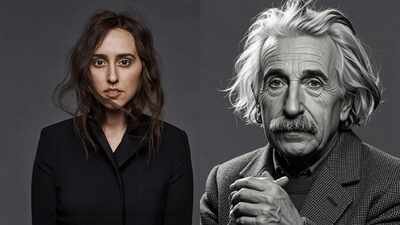
While most teens her age were buried in homework and distracted by their first crushes, Sabrina Gonzalez Pasterski was aiming for the sky, literally. She had built her own single-engine plane and was flying it solo years before she was even old enough to drive. That kind of nerve gets noticed. Blue Origin, the space company founded by Jeff Bezos, came calling with a job offer. Brown University went further and offered an assistant professorship with a package of $1.1 million, the kind of offer most graduate students only dream about. But Pasterski is not ‘most students’, so she said ‘no’ to all of it. The physics girl is now dubbed the ‘next Albert Einstein’.
Born to win
The genius was born in 1993 to a Cuban-American mother and a Polish-American father, both lawyers. Pasterski grew up in Chicago. As a child, she was obsessed with planes. At 12, she started building an actual single-engine aircraft from a kit, a Zenith CH 601 XL. It took her two years. By 14, she was flying it solo, before she was even old enough for a driving licence. She attended the Illinois Mathematics and Science Academy, where she made the semifinalist round for the U.S. team at the International Physics Olympiad. Along the way, she interned at NASA’s Kennedy Space Center and Blue Origin, well before either company had any idea what she would eventually turn down.
6 May 2026 | 16:56
What are the three things that make you instantly happy?
In 2010, when she applied to MIT, they waitlisted her. But soon enough, they saw the video of the plane she had built. They knew what this young girl was capable of. As expected, she graduated first in MIT’s physics department with a perfect 5.0 GPA, becoming the first woman in roughly two decades to top the department and the first woman to win the school’s Orloff Scholarship.
Just a physics girl with infinite dreams
While her peers at MIT were busy popping champagne, celebrating graduation, and calling it a day, she went to Harvard and earned a PhD in 2019. At Harvard, working under physicist Andrew Strominger, Pasterski dove into quantum gravity. Alongside Strominger and physicist Alexander Zhiboedov, she discovered the ‘spin memory effect’, which helps explain gravitational waves and how information is stored in spacetime. The work undoubtedly caught the attention of Stephen Hawking. That’s right. He cited her work in his final papers before bidding adieu to this universe.
Turning down millions for a bigger question
After Harvard, Pasterski went to the Princeton Center for Theoretical Science for a postdoctoral fellowship. She discovered infinite-dimensional symmetry enhancements of the S-matrix and helped build a framework for extending infrared physics into other areas of theory. Top tech companies and influential figures across the world wanted to hire her. Even NASA came knocking, but she turned it down.In 2021, she joined the Perimeter Institute for Theoretical Physics in Waterloo, Canada, as a research faculty member. She was just 27, the youngest faculty member there. She founded the Celestial Holography Initiative, a research programme working to unite spacetime with quantum theory. In 2023, the Simons Foundation backed the research with an $8 million grant, bringing together thirteen principal investigators from institutions including Harvard, Oxford, Cambridge, and the Institute for Advanced Study.Pasterski has been called the next Einstein more times than she probably wants. But why does the tag stick? Because Einstein cracked gravity, and she is trying to crack what gravity is made of at a level even he never reached. Turning down million-dollar offers along the way only underlines how genuine her pull towards physics actually is. Her interview with Discovery Canada perhaps explains it best: “I don’t know exactly what problem I will or will not end up solving, or what exactly I’ll end up working on in a couple of years,” the physics girl said. “The fun thing about physics is that you don’t know exactly what you’re going to do. And normally things just change very quickly, kind of irreversibly, if they’re really right.”