“Sing in me, Muse, and through me tell the story of that man skilled in all ways of contending. Sing to me of the man of twists and turns driven time and again off course.”
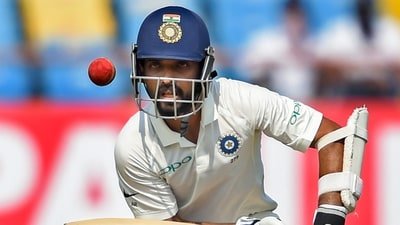
On the day India’s 278th Test cap called time on his long international career, the opening lines of The Odyssey—across centuries of translations—inevitably brought Ajinkya Rahane to mind.
The Mumbaikar was a man of many faces, a cricketer of many flourishes and more than one peak. A classy batsman of orthodox technique and unorthodox grit. He looked adversity in the eye, gritted his teeth, and got straight back to work.
Resilient and determined, a perfectionist and a quiet, understated leader—that was Rahane. A man at his most dangerous when cornered, with his back against the wall. His finest innings invariably arrived in the toughest circumstances.
It began, fittingly, in adversity. Only his third Test took him to Durban, where twin fifties on a seaming pitch first hinted that here was a batsman unbothered by reputations. New Zealand brought his maiden Test hundred in Wellington a few months later, and by 2016 he was rewriting record books at Indore, sharing a then world-record 365-run partnership with Virat Kohli en route to 188, still his highest Test score.
ALSO READ: Under Virat Kohli’s giant shadow, Ajinkya Rahane’s international journey delivered a lot less than it promised
In between came Lord’s. India were reeling at 145 for seven when Rahane produced a watchful 103, dragging the visitors to a defendable total before helping script their first Test victory at the Home of Cricket in 28 years. His name was etched onto the Lord’s Honours Board.
Between 2017 and early 2019, Rahane endured the leanest patch of his career. Barely over a hundred runs across a dozen Test innings, an average scraping into double figures, and a chastening home series against Sri Lanka. It was a far cry from the fearless 26-year-old who, on his maiden tour of Australia in 2014-15, had hammered 399 runs against a pace attack that simply could not contain him.
But with Rahane, the numbers rarely told the full story. He returned to the nets, back to domestic cricket, rebuilt his game brick by brick, and when Australia came calling again in 2020, he was ready.
Melbourne would become the stage for his greatest triumph—twice over. First in 2014, with a counter-attacking 147 that turned the Test on its head. Then, six years later, with the innings that came to define his career.
Handed the captaincy after India’s humiliating 36 all out in Adelaide, Rahane walked into the MCG carrying a shell-shocked dressing room on his shoulders. He responded with a composed, match-winning 112. India won that Test. Then they won the series. It remains one of the greatest overseas triumphs in Indian Test history.
The Oval carried a different weight altogether. Dropped from the side for over a year, Rahane returned for the 2023 World Test Championship final and made a defiant 89 against one of the finest pace attacks in world cricket—Pat Cummins, Mitchell Starc and Scott Boland. India lost the final, but Rahane’s innings served as a timely reminder of everything the side had missed.
He was never as glamorous as the giants who occupied India’s No. 4 before and after him. Sachin Tendulkar embodied timeless elegance. Virat Kohli became relentless, confrontational excellence.
Rahane was something else entirely.
Safe. Steady. Reassuring.
When beaten outside off stump, he would step away, take a breath, adjust his gloves, reset, and begin again. There was almost something deliberately understated about him. Not boring to watch—far from it—but refreshingly free of theatre. No extravagant celebrations. No verbal battles. Just quiet confidence expressed through immaculate red-ball batting.
South Africa. New Zealand. Lord’s. The Oval. The MCG—not once, but twice.
Wherever the challenge was greatest, Rahane usually found a way.
His numbers, while never overwhelming, tell the story of remarkable consistency: 85 Tests, 5,077 runs at an average of 38.46, 12 hundreds and 26 fifties, with a highest score of 188.
Add 90 One-Day Internationals, 20 T20Is, and an IPL career spanning six franchises—culminating in a long-awaited title with Chennai Super Kings in 2023 and a stint as Kolkata Knight Riders captain—and the portrait is complete: a cricketer who simply loved playing the game and never stopped answering its toughest questions.
There is a clear before and after Rahane in Indian Test cricket.
Before him, winning a Test series in SENA countries was a rarity. During his era, it became an expectation.
He was never the architect of that transformation in the way Kohli was. But Rahane was unquestionably one of its strongest pillars—the dependable backbone of an Indian middle order that carried the team to the summit of Test cricket.
He never stopped punching above his weight.
And perhaps that is how Ajinkya Rahane will be remembered—not as the loudest voice or the brightest star, but as Indian cricket’s enduring Odysseus, forever finding a way home through every storm.